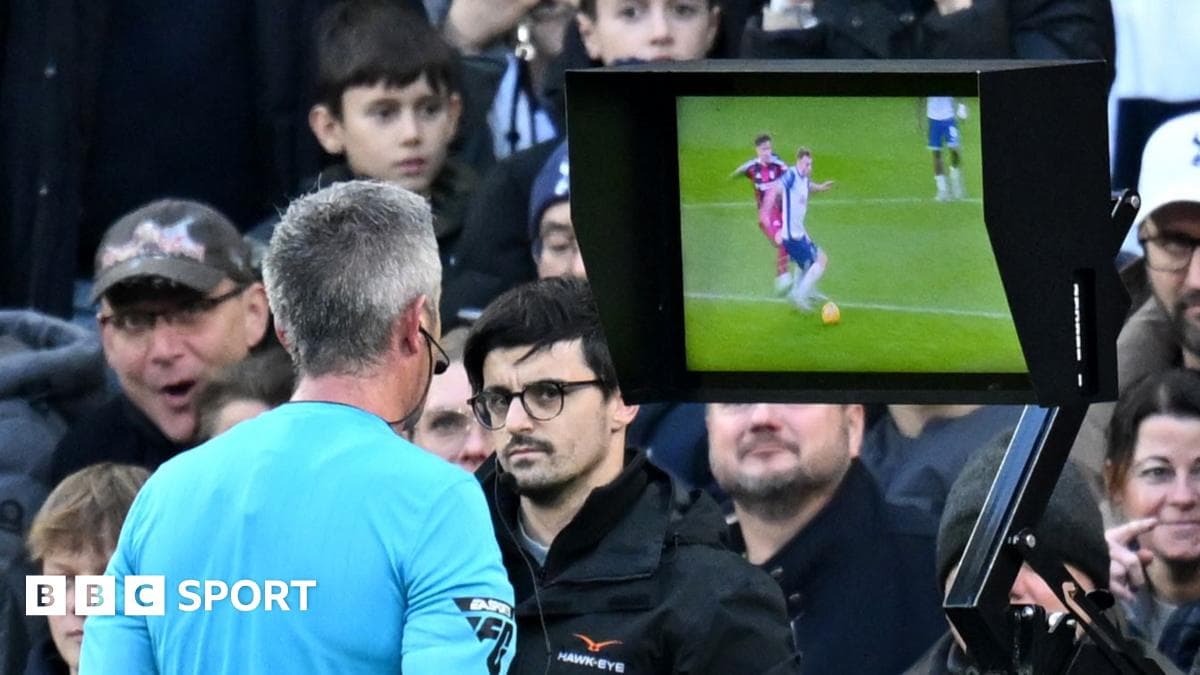
The video assistant referee (VAR) was introduced to the Premier League in 2019
Published March 5, 2026 • Source: https://www.bbc.com/sport/football/articles/cx28wjznvqyo
By Dale Johnson (https://www.bbc.co.uk/sport/topics/cglgnp4394wt)
Football issues correspondent
Bill Shankly once said that "football is a simple game, complicated by people who should know better".
Shankly, in charge of Liverpool between 1959 and 1974, managed in a simpler era, a time without rolling news, social media and, of course, the video assistant referee (VAR).
If he were managing today, he might consider using stronger words.
From handball, to offside and VAR, it has become difficult for supporters to follow what is going on.
Has football really become a more complicated game?
And if so, who is to blame?
Handball - the law that has everyone guessing
There seems to be no greater confusion than the handball law.
It has changed so many times in recent years that it has been pretty much impossible to keep up.
"I just hate the handball rule," Alan Shearer told BBC Sport. "They have messed it up.
"They'll say that things are better in the Premier League than they are abroad, but that doesn't wash with me.
"It is so messed up in every single way, there is 'deliberate', 'proximity', 'natural', 'unnatural' - there are so many different ways they have to interpret things and it isn't fit for purpose."
Shearer did not even mention the contradictory accidental attacking handball law which automatically disallows a goal.
It created an offence for a striker which a defender would get away with.
The law's application might not feel like it is better in the Premier League but - in terms of penalties awarded - it demonstrably is, with fewer penalties awarded on average than in any of the other major European leagues.
But that does not mean it is good.
There is a misconception that the handball law was changed for VAR, but it happened the other way around.
The International Football Association Board (Ifab) started work on redefining handball in 2014 - two years before trials of VAR began.
Those changes created a menu of justifications for handball.
When the video assistant came into the game, it was too easy to give penalties. It just required finding one clause to tick off - and there was a huge spike in spot-kicks across leagues.
VAR proved to be incompatible with the new law. It has been changed many, many times in recent seasons to try to find a solution.
Fans would love to go back to the days when handball really was a basic judgement call.
But the genie is out of the bottle.
Any change would have to be defined. And with that new definition to contend with, we would probably be no better off.
Ducking and diving - the subjective offside
There have been several contentious subjective offside decision this season - when a player does not touch the ball but impacts an opponent.
Take Virgil van Dijk's disallowed goal for Liverpool during their 3-0 defeat at Manchester City on 9 November.
Andrew Robertson ducked under the ball and was ruled to be affecting goalkeeper Gianluigi Donnarumma. It caused a lot of controversy.
There were complaints that the lawmakers had tinkered too much - that offside was now too complicated.
Yet this has always been in the laws.
The 1903-04 edition, external (https://downloads.theifab.com/downloads/laws-of-the-game-1903-04?l=en) states that a player cannot "in any way whatever interfere with an opponent or the play".
Otherwise attackers would have carte blanche to stand close to opponents, or make movements, in the hope of influencing a goal.
Considering how the "dark arts" seem to be on the rise, changing this would have unintended consequences.
It might be annoying, and there will always be edge cases, but this is not going to change.
'Deliberate play' - not all is what it seems
When is deliberately playing the ball not deliberate? Well, when it is a "deliberate play".
And that sums up this law perfectly.
It was introduced in 2016-17 season to define how a touch by a defender might reset an offside phase.
But referees were applying this strictly, so offside players were benefitting unfairly.
It was tweaked after Kylian Mbappe's controversial winning goal for France against Spain in the 2021 Uefa Nations League final.
Eric Garcia had stretched for a ball, made a small amount of contact and it played Mbappe onside.
The Ifab clarified the law to say a defender needed to have the expectation of a controlled outcome.
But it is still called "deliberate play".
So, a defender can deliberately play the ball - but if they do not have control it is not a "deliberate play".
Clear as mud.
Double jeopardy and advantage - the goalposts keep moving
Ifab has been messing around with the considerations for denying an obvious goalscoring opportunity (Dogso) when a penalty has been awarded too.
If a defender makes an attempt to play the ball or challenge the opponent, it is a yellow card.
But now it has to be a really cynical foul, or a push or a pull, for there to be a red card.
If a defender makes a challenge and the ball is anywhere in the vicinity, it is only a caution.
What was a red card a few years ago would not be today.
Take the law concerning advantage, too.
Gabriel Martinelli was sent to the ground by Chelsea's Pedro Neto on Sunday.
The Arsenal forward got to his feet and continued the attack - but referee Darren England stopped the game and showed Neto a second yellow card.
Understandably, many Gunners fans were annoyed that the referee did not play advantage.
But the law says advantage cannot be played when a red card needs to be shown - unless the attacking team could score immediately.
Arsenal fans did not know and the boos rang out.
So is VAR to blame?
We all know the frustration VAR has brought.
It has slowed down the game and led to the microscopic offsides that most fans hate.
More crucially, it has turned the game into an exam.
Fans used to be able to sit and a watch a match, disagree with a decision and get on with their lives.
Today, there is a detailed explanation of every little thing - from a potential red card, to a player's arm position, to the convoluted considerations for violent conduct.
Supporters might feel a little patronised.
Sometimes the justification for their opinion is simply years watching the game.
Now they are being told they are wrong because of a collection of clauses hidden away in guidance shown only to referees.
VAR has changed football from a simple game into a technical debrief.
But wait... it is going to get a whole lot more complicated
Saturday's Ifab meeting was one of the busiest there has been.
A raft of law changes were introduced for the World Cup and the 2026-27 season onwards.
It is going to make the game even more complicated for anyone who has not been following.
There will be VAR checks on corners, and to review second yellow cards once awarded. But not goal-kicks and potential second yellow cards.
There will be a five-second countdown on throws and goal-kicks. But not corners.
Substituted players will have 10 seconds to leave the field.
Players who get treatment will have to stay off for one minute.
Dogso is going to get more complicated, too.
And then there is the trialling of Arsene Wenger's "daylight" offside idea.
The game is not going to get any simpler.